
Postpaid vs. prepaid: what the difference means for you
The first split you will encounter when looking at cell phone plans is postpaid versus prepaid. A postpaid plan works like a utility bill: you use the service all month, then pay at the end. Carriers typically run a credit check when you sign up, and you may be asked to sign a contract, though month-to-month postpaid plans exist too.
A prepaid plan flips that order. You pay before the service period starts, and your service runs until the money runs out or the month ends. No credit check, no contract. If you stop paying, the service stops.
Neither type is objectively better. Postpaid plans often include more features and priority network access. Prepaid plans are simpler to budget and easier to leave without an early-termination fee. Someone on a fixed income or trying to avoid surprise bills may find prepaid easier to manage. Someone who travels frequently and wants a consistent plan with extras like device financing may prefer postpaid.
Postpaid plan
A cell phone plan where you pay your bill at the end of each billing cycle, after you have already used the service. It usually requires a credit check.
Prepaid plan
A cell phone plan where you pay upfront before using the service. There is no contract and typically no credit check.
MVNO
Mobile Virtual Network Operator. A smaller wireless carrier that does not own its own cell towers but leases access to a major carrier's network.
Deprioritization
A practice where your data speeds may be temporarily slowed during busy network periods once you have used a certain amount of data that month.
Mobile hotspot
A feature that lets your phone share its cellular data connection with another device, like a laptop or tablet, over Wi-Fi.
Data cap
A limit on how much data you can use in a billing period before your speeds are slowed or additional charges apply.
What 'unlimited' actually means on a cell plan
The word 'unlimited' appears on most plans today, but it does not mean the same thing as having no restrictions at all. Almost every unlimited plan includes a deprioritization threshold, a specific number of gigabytes per month after which your speeds may be slowed when the network is busy. This threshold can range from around 22 GB to 100 GB depending on the plan tier.
Slowing only happens during congestion, so in a rural area with little traffic, you might never notice it. In a crowded city during rush hour, speeds after the threshold can drop enough to make video streaming difficult.
Unlimited plans also vary on what they include for mobile hotspot data. Some give you a set amount of fast hotspot data each month, then slow it down. Others include no hotspot at all. If you regularly connect a laptop to your phone's data connection, this distinction matters.
MVNOs: smaller carriers that use the same towers
You may have seen carriers advertised that you do not recognize alongside the big national names. Many of these are MVNOs, or Mobile Virtual Network Operators. An MVNO does not build or own cell towers. Instead, it pays one of the major carriers to use their network and then resells that access under its own brand and pricing structure.
Because MVNOs have lower overhead, they often charge less per month than the major carrier whose network they use. The trade-off is that MVNO customers may receive lower network priority during peak congestion periods. For most everyday use, this difference is minor. For someone in a densely populated area who streams heavily during commute hours, it can occasionally be noticeable.
Coverage depends on the underlying network
When you sign up with an MVNO, your coverage area is generally the same as the major carrier whose network the MVNO uses. However, during periods of heavy network traffic, MVNO customers are sometimes deprioritized below the major carrier's own customers. This matters most in densely populated areas during peak hours.
If you are also evaluating your home internet setup, the same kind of fine-print review applies there. See how internet plan terms work for a parallel breakdown of what providers put in the fine print.
Data, talk, and text: what you are actually paying for
Cell plans bundle three things: voice calls, text messages, and mobile data. For most people today, data is the variable that drives cost, because calls and texts are included in virtually all plans at no practical limit.
Data is measured in gigabytes (GB). To give you a rough sense of scale: streaming one hour of standard-definition video uses roughly 1 GB. Sending emails and browsing web pages for a full day might use under 200 megabytes (MB), which is one-fifth of 1 GB. Streaming music for an hour uses around 50 to 150 MB depending on audio quality.
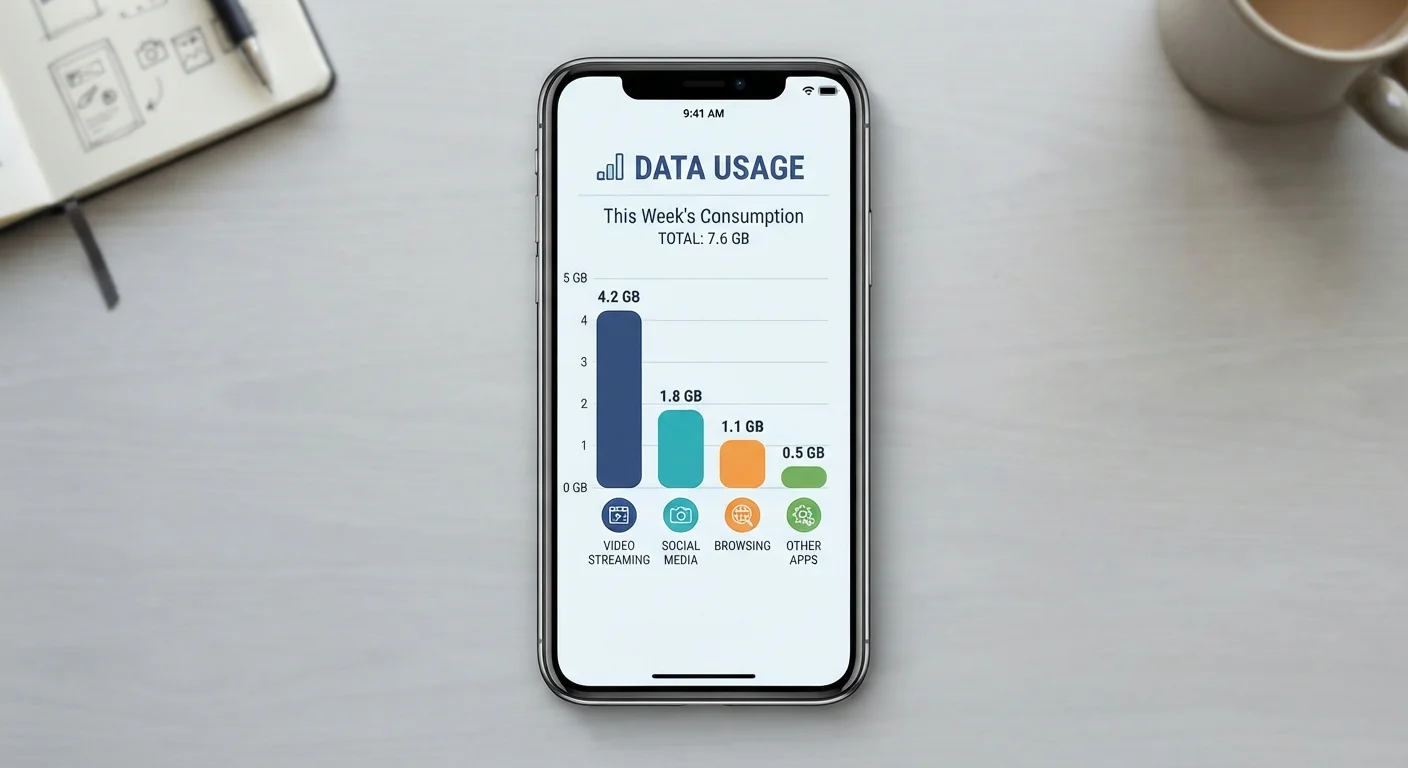
These numbers vary by app and quality settings, but checking your current monthly usage in your phone's settings gives you a real baseline, which is more useful than any estimate. If you are also figuring out which device to use, the differences between smartphones and tablets affect how much data you are likely to use day to day.
Check your usage before you shop
Before comparing any plans, look up your actual data usage in your phone's settings. On iPhone, go to Settings > Cellular. On Android, go to Settings > Network > Data usage. This number tells you whether a low-data plan covers your habits or whether you need more headroom.
How to read a plan before you sign up
When you look at a plan, the advertised price is the starting point, not the full picture. Ask for the total monthly cost including taxes and fees before committing. On some plans, government taxes and carrier surcharges add a noticeable amount to the base price.
Look at four specific things in the plan details: the deprioritization threshold (how much data before potential slowdowns), the hotspot allowance, whether international calling or texting is included, and whether the price is a promotional rate that increases after a set number of months.
If the plan comes with a device payment, that charge is separate from the service cost and continues until the device is paid off. Paying for a device in installments does not make the plan itself cheaper; it spreads a purchase cost across your monthly bill.
For anyone also reviewing their broader home connectivity setup, what to check before switching internet providers covers many of the same contract and fee questions in a home internet context.