


What the top line on your pay stub actually means
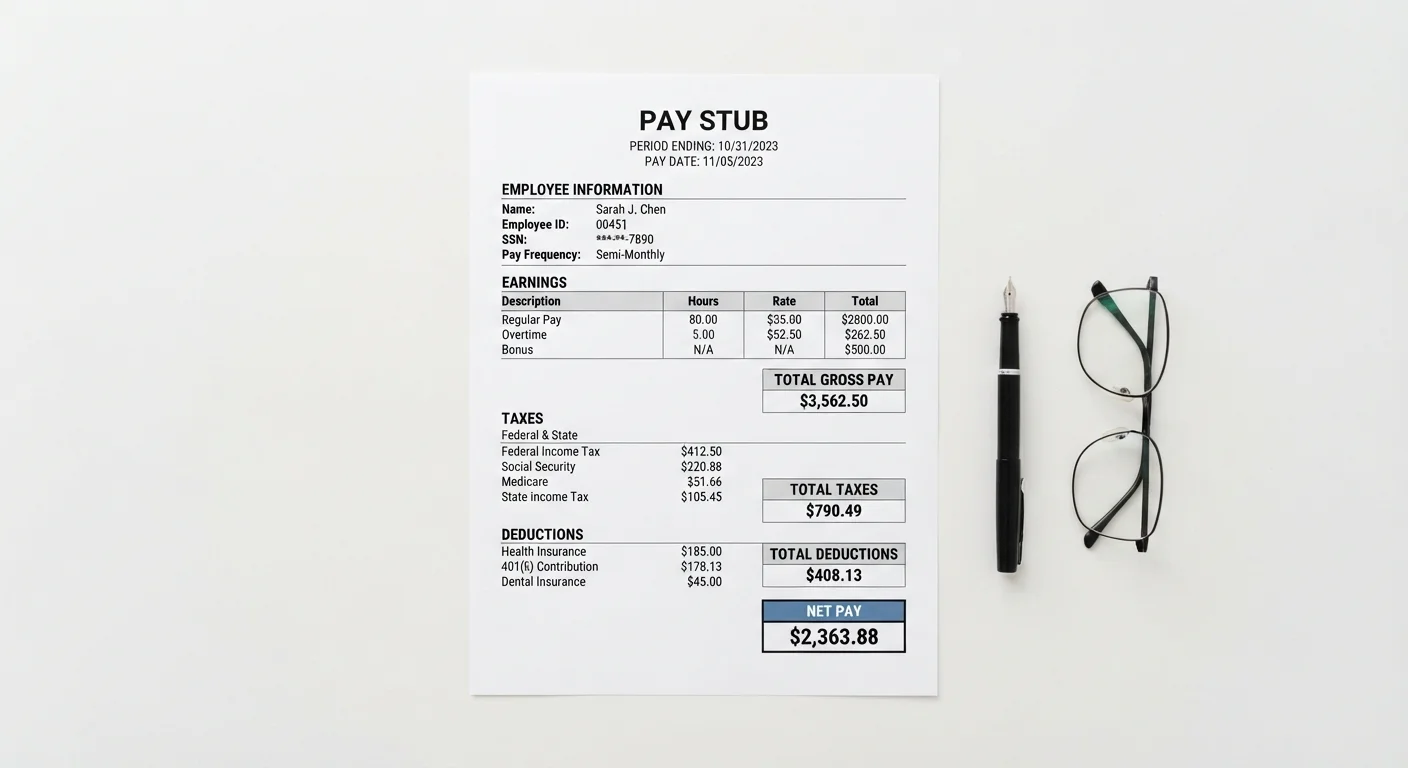
Your gross pay is the number your employer promised you, whether that is an annual salary divided by pay periods or an hourly rate multiplied by hours worked. It is the starting point, not the number you take home.
Below that number, your pay stub lists every deduction in order. Federal income tax withholding usually takes the largest share for most workers, but it is not calculated at one flat rate. Instead, it is based on your income level and the instructions you gave on your W-4 form. The more allowances or adjustments you claimed, the less is withheld each period.
The W-4 is not a set-it-and-forget-it form. Life changes, such as getting married, having a child, or taking on a second job, can affect how much you should withhold. The IRS Tax Withholding Estimator (available at irs.gov) is a free tool that helps you check whether your current withholding is on track.
FICA: the two taxes most people overlook
Below federal withholding, most pay stubs list Social Security and Medicare taxes separately. Together they are called FICA taxes.
Social Security takes 6.2% of your wages up to a wage base that the IRS adjusts periodically. Medicare takes 1.45% with no cap. Employees earning above a separate threshold also owe an additional 0.9% Medicare surtax, though this is reconciled at tax filing time rather than always withheld at the paycheck level.
Your employer pays matching amounts on their side. That employer share does not appear on your stub because it comes out of the business's payroll costs, not your wages. Still, it is part of the total cost of employing you.
7.65%
Combined FICA rate paid by employees
Per IRS guidance: 6.2% Social Security plus 1.45% Medicare, applied to most wage earners.
~30%
Share of gross pay lost to all deductions for median earners
Federal Reserve and IRS data suggest federal taxes, FICA, and common benefits deductions together often reduce gross pay by roughly this amount for middle-income workers, though the exact figure depends on income level, state, and elected benefits.
Pre-tax deductions and why they matter
Pre-tax deductions reduce the amount of your income that is subject to federal and, in most cases, state income tax. Common examples include contributions to a traditional 401(k) or 403(b) plan, premiums for employer-sponsored health, dental, and vision insurance, and contributions to a Health Savings Account (HSA) or Flexible Spending Account (FSA).
If you contribute $200 per paycheck to a traditional 401(k), for instance, your taxable income for that period is reduced by $200. You still see the deduction on your stub, but it comes off before the tax calculation runs. That is different from simply paying $200 out of your net check.
Post-tax deductions, by contrast, are taken after your tax liability is figured. A Roth 401(k) contribution works this way: you pay taxes on that money now, but qualified withdrawals in retirement are tax-free. Wage garnishments for debt or child support are also post-tax.
State taxes, local taxes, and other line items
Depending on where you live and work, your stub may also show state income tax, local or city tax, state disability insurance (SDI), or paid family leave (PFL) contributions. These amounts vary widely by location.
Some workers see deductions for union dues, life insurance premiums, or employee stock purchase plans. Each of these has its own tax treatment, and the stub should label them clearly. If a line is unclear, your HR or payroll department can explain what it covers.
Just as you can read a utility bill line by line to spot billing errors or inefficiencies (see what your utility bills are actually telling you), you can read your pay stub the same way. An error in your benefits enrollment or a leftover deduction from a plan you dropped can quietly reduce your take-home pay for months.
This article is for general informational purposes only and is not personalized tax, legal, or financial advice. Tax rules and rates change, and individual circumstances vary. Consult a licensed tax professional or financial adviser for guidance specific to your situation.